Not every dent requires a full-panel respray or costly body filler. Auto paintless dent repair has changed the way vehicle owners approach minor body damage, offering a faster, more affordable solution that fully preserves the original factory finish. For drivers in Jimboomba, Flagstone, and Greenbank, understanding which dents qualify for this technique helps avoid unnecessary repair costs and preserve vehicle resale value.
What Does Auto Paintless Dent Repair Actually Involve?
Traditional dent repair typically involves sanding, filling, priming, and repainting the affected panel. Auto paintless dent repair takes a fundamentally different approach.
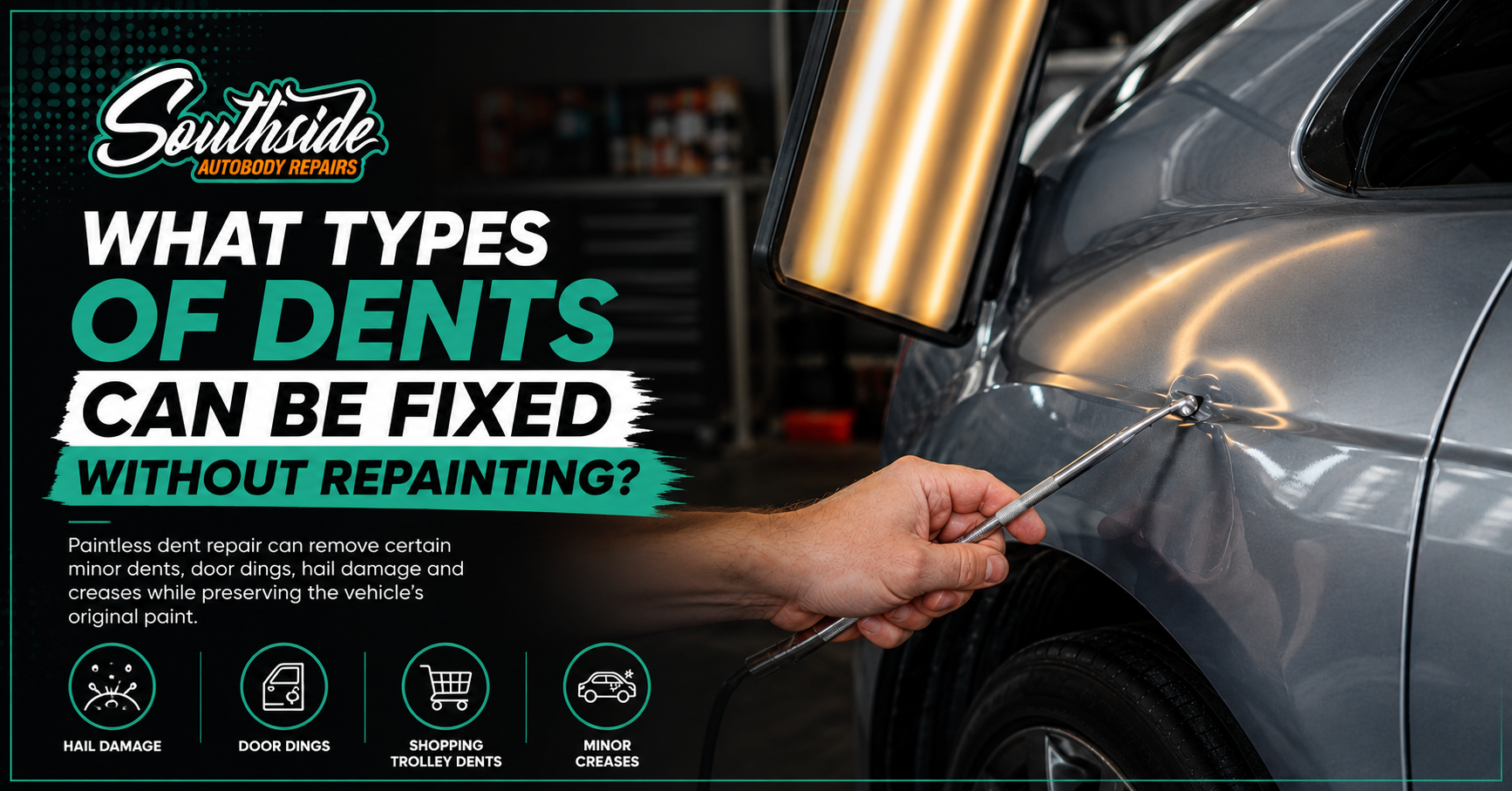
Specialist technicians use precision rods, picks, and reflective lighting boards to work the metal back to its original contour from behind the panel. There is no filler, no primer, and no paint involved at any stage of the process.
The result is a repair that is:
- Invisible to the eye once completed
- Faster to complete than conventional body repair methods
- Significantly more cost-effective for the vehicle owner
- Protective of the vehicle’s original factory paint finish
- Better for resale value as the panel remains entirely unreprinted
According to the Motor Trades Association of Queensland (MTAQ), paintless dent repair has become one of the most in demand services across Queensland’s auto body sector, particularly following hail events and for minor collision damage on newer vehicles.
Dent Types That Respond Well to Paintless Repair
Not every dent is the same, and the technique works best on specific types of damage.
Hail Damage
Hailstones create multiple shallow, rounded dents across bonnets, roofs, and boot lids. These are among the most ideal candidates for paintless repair because the paint surface remains unbroken, and the dent shape responds well to precision manipulation.
Car Park Dents and Door Dings
Caused by other vehicle doors or shopping trolleys making contact at low speed. They are usually small, circular or oval in shape, and located on flat panel sections where technician access from behind is straightforward.
Minor Creases
Shallow creases from low-speed impacts, such as reversing into a post, can often be resolved with paintless techniques, provided the paint has not cracked or chipped along the crease line.
Body Line Dents
Dents along a panel’s character line require a higher skill level, but experienced technicians can often treat them without repainting.
Round Impact Dents
Caused by footballs, falling branches, or low-speed debris strikes, these tend to be clean and consistent in shape, making them highly suitable for paintless methods.
When Paintless Repair Is Not the Right Approach
Understanding the limitations is just as important as knowing the benefits.
Paintless dent repair is generally not suitable when:
- The paint has cracked, chipped, or flaked at the point of impact
- The metal has been stretched significantly beyond its elastic limit
- The dent is in an area where panel access from behind is not possible
- Rust has formed inside or around the damaged area
- The damage involves structural components rather than outer body panels
In these cases, conventional repair methods are the appropriate path forward. A qualified technician will assess the damage and provide an honest recommendation based on what delivers the best long-term result.
The Repair Process Step by Step
The auto paintless dent repair process follows a consistent series of stages regardless of dent size or location:
- Initial assessment — technician examines paint integrity, dent depth, and panel access points
- Lighting setup — a reflective board is positioned to reveal the full contour of the dent clearly
- Tool selection — appropriate rods and picks are chosen based on dent size and panel location
- Panel manipulation — metal is carefully worked back to its original shape from behind the panel
- Final inspection — the panel is checked under lighting for any remaining surface imperfections
A single dent typically takes between 30 minutes and a few hours to repair, depending on severity and panel location.
Dent Types and Timeframe Needed for Repair
| Dent Type | Paint Affected | PDR Suitable | Typical Timeframe |
|---|---|---|---|
| Hail Damage | No | Yes | Half day to full day |
| Door Ding | No | Yes | 30 to 60 minutes |
| Minor Crease | Sometimes | Assess first | 1 to 2 hours |
| Body Line Dent | Sometimes | Assess first | 1 to 3 hours |
| Deep Impact Dent | Often | No | Conventional repair |
Book Your Paintless Dent Assessment at Southside Autobody Repairs
Southside Autobody Repairs provides professional auto paintless dent repair services for vehicles of all makes and models across Jimboomba, Flagstone, and Greenbank. Every job starts with an honest evaluation of the damage to confirm whether paintless repair is the right approach or whether a different method will deliver a better result.
Our team brings genuine expertise to every assessment, working to restore your vehicle’s appearance without unnecessary resprays or inflated repair costs. Whether you are dealing with hail damage across a full panel or a single door ding from a car park, the right advice from a qualified technician makes all the difference.
Call us today to request your free quote and book your assessment at our workshop.